7 Mistakes Small Businesses Make with Ransomware Protection
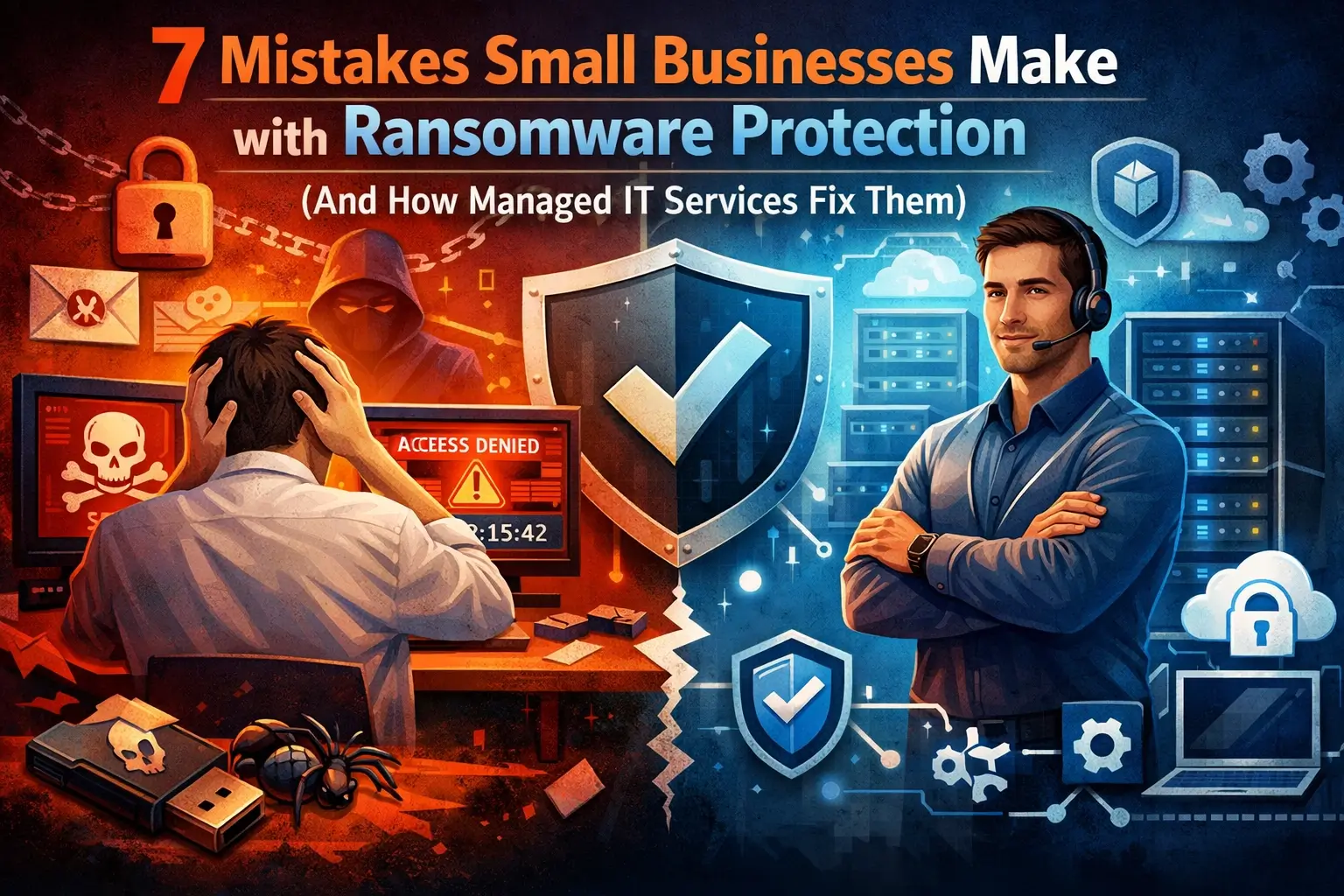
Ransomware attacks aren't just a problem for Fortune 500 companies anymore. Small businesses are now the primary target, and for good reason. Cybercriminals know that smaller organizations often lack dedicated IT security staff, run on tight budgets, and make critical mistakes that leave their data wide open.
The bad news? One successful ransomware attack can shut down your operations for days, cost tens of thousands of dollars in recovery expenses, and destroy years of customer trust.
The good news? Most ransomware attacks succeed because of preventable mistakes. With 18+ years helping small businesses protect their data, we've seen these vulnerabilities firsthand, and more importantly, we know exactly how to fix them.
Here are the seven most common ransomware protection mistakes we see SMBs make, and how working with a managed IT services provider eliminates each one.
Mistake #1: Running Outdated Software and Ignoring Security Patches
Here's the thing about software vulnerabilities: once they're discovered, hackers have a field guide to breaking in. When Microsoft or your software vendor releases a security patch, they're essentially publishing "here's the hole we just fixed", which means cybercriminals immediately know where to attack systems that haven't updated yet.
Small businesses often delay patches because they're worried about downtime, compatibility issues, or simply don't have IT staff dedicated to monitoring updates. But every day you wait is another day your systems are exposed to known exploits.
How managed IT services fix it:
At Kilpatrick IT Solutions, patch management is baked into our flat-rate service model. We automate critical security updates across your entire infrastructure and test patches before deployment to avoid disruptions. You get enterprise-level protection without the enterprise-level IT team.

Mistake #2: Using Weak Passwords (Yes, Still)
We all know we should use strong passwords. Yet "123456" and "password" remain among the most common passwords in business environments. Even worse is password reuse: when one account gets compromised, attackers try those same credentials everywhere.
Weak passwords are ransomware's front door. Once hackers gain access to one email account through a stolen or guessed password, they can move laterally through your network, access sensitive files, and deploy ransomware across your entire organization.
How managed IT services fix it:
We enforce password policies that actually work: including complexity requirements, regular rotation schedules, and most importantly, multi-factor authentication (MFA) on all critical accounts. MFA alone blocks 99% of automated credential based attacks. We handle the setup and make it seamless for your team.
Mistake #3: Not Having Tested, Offline Backups
"We have backups" is what every small business owner tells us: until ransomware encrypts both their live data and their backup files. Modern ransomware specifically targets backup systems, knowing that's your only way to recover without paying a ransom.
Having backups isn't enough. You need regular, tested, offline backups that ransomware can't reach. And you need to actually verify those backups work before disaster strikes.
How managed IT services fix it:
We implement 3-2-1 backup strategies: three copies of your data, on two different media types, with one copy completely offline and offsite. We test restoration quarterly to ensure your backups actually work when you need them. If ransomware hits, you'll be back online within hours: not days or weeks.
Mistake #4: Skipping Regular Employee Security Training
Your firewall might be bulletproof, but if someone clicks a phishing link and enters their credentials, none of that matters. Human error remains the number one entry point for ransomware attacks.
A single annual "cybersecurity training" session doesn't cut it anymore. Phishing tactics evolve constantly, and employees need regular reinforcement to spot increasingly sophisticated social engineering attempts.
How managed IT services fix it:
We provide ongoing security awareness training tailored to the actual threats your team faces. Our programs include simulated phishing campaigns that teach employees to recognize red flags in real-time. Short, frequent training sessions work far better than once-a-year marathons, and we handle all of it so you don't have to become a cybersecurity instructor.

Mistake #5: Relying on Basic Antivirus Software Alone
That antivirus software you installed three years ago? It's probably not enough anymore. Modern work environments include laptops, phones, tablets, home office setups, and cloud applications: each one a potential entry point for ransomware.
Traditional antivirus programs check for known malware signatures, but today's ransomware variants morph constantly to evade detection. You need endpoint detection and response (EDR) solutions that identify suspicious behavior, not just known threats.
How managed IT services fix it:
We deploy AI-driven endpoint protection across all your devices: including employees' mobile phones and home computers when they access company data. Our centralized security platform monitors every endpoint 24/7 and automatically responds to threats before they spread. You get enterprise grade protection without needing in-house security analysts.
Mistake #6: Thinking "We're Too Small to Be Targeted"
This might be the most dangerous misconception of all. Small businesses often assume hackers only go after big corporations with millions to lose. The reality? Cybercriminals prefer smaller targets precisely because you have fewer defenses.
Ransomware gangs use automated tools to scan thousands of businesses simultaneously, looking for easy targets. They don't care about your company size: they care about whether your systems are vulnerable. And with the rise of "ransomware-as-a-service," even low-skill criminals can launch sophisticated attacks.
The ransomware landscape has evolved beyond simple file encryption too. Now attackers use double extortion tactics: they steal your data first, then threaten to publish it publicly if you don't pay: even if you restore from backups.
How managed IT services fix it:
Cybersecurity services for small business are exactly what we specialize in at Kilpatrick IT Solutions. We bring you threat intelligence about what's actually happening in the wild, implement proportionate defenses for your risk level, and create incident response plans before an attack occurs. You get realistic threat assessment from professionals who've seen it all, not fear mongering or head-in-the-sand optimism.
Mistake #7: Not Monitoring Your Network
If ransomware gets into your network, how long until you notice? For many small businesses, the answer is "when files won't open anymore": by which point the damage is done.
Relying on a single security tool creates blind spots. Defense-in-depth strategies include firewalls, intrusion detection systems, network segmentation, and continuous monitoring. Without these layers, suspicious activity spreads undetected until a full-blown infection forces your hand.
How managed IT services fix it:
Our approach includes comprehensive network monitoring that flags anomalies in realtime: like unusual file access patterns, unexpected data transfers, or suspicious login attempts. We implement network segmentation to contain threats if they do breach one area. And because we monitor 24/7, we can respond to emerging threats at 3 AM on Sunday just as effectively as Tuesday afternoon.

The Bottom Line: Ransomware Protection You Can Actually Afford
Small businesses shouldn't need a dedicated security operations center to stay safe from ransomware. That's the whole point of managed IT services: you get enterprise-level protection through a flat rate, scalable model that fits your budget.
After 18+ years protecting small businesses from tech induced headaches and data security threats, we've learned that ransomware protection isn't about buying the most expensive tools. It's about implementing the right combination of technology, processes, and human training: and actually maintaining them consistently.
Every business we work with gets the same proactive approach: automated patch management, enforced security policies, tested backups, employee training, advanced endpoint protection, realistic threat assessment, and 24/7 monitoring. No surprise bills. No wondering if you're actually protected.
Want to see how we've helped other small businesses strengthen their ransomware defenses? Check out our case studies, including how we kept a local digital marketing agency secure through the remote work transition.
Ready to fix these vulnerabilities before they become emergencies? Get in touch and let's talk about protecting what you've built.